
Laminectomy, Laminotomy, and Spinal Fusion: What’s the Difference


When you are researching treatments for severe back and leg pain, you are quickly confronted with an overwhelming amount of medical jargon. Terms like "laminectomy," "laminotomy," and "spinal fusion" are often thrown around interchangeably by patients, but clinically, they represent vastly different surgical approaches with entirely different recovery profiles.
Understanding these differences is crucial for advocating for your own spinal health and ensuring you choose a procedure that matches your lifestyle goals.
A laminectomy completely removes the lamina (the bony arch of the vertebra) to create space, a laminotomy removes only a small targeted portion of it, and a spinal fusion permanently connects two or more vertebrae using hardware to stop spinal movement entirely. A LESS™ invasive decompression transcends these traditional categories by focusing strictly on tissue preservation and motion retention.
Comparing Spine Surgery Approaches
Here is a clear breakdown of how these three traditional procedures impact your body:
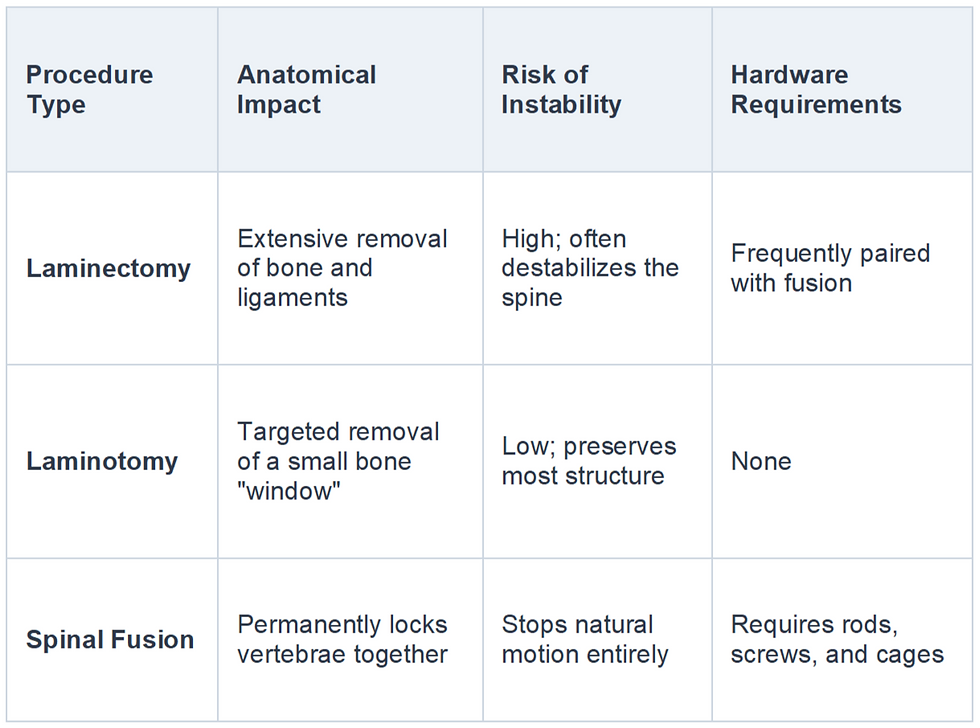
While a laminectomy creates a lot of space for the nerves, removing that much bone often makes the spine unstable, forcing the surgeon to perform a spinal fusion to bolt the spine back together.
THE ELID™ ADVANTAGE: DECOMPRESSION WITHOUT DESTRUCTION
You do not always have to choose between nerve relief and spinal mobility. The ELiD™ platform advances the tissue-sparing concept of a laminotomy. Using defined anatomical pathways (like ELiD-IL™ for central stenosis), surgeons can directly resect hypertrophic ligaments and bone spurs without removing the entire lamina. This allows for total nerve decompression without the need for destructive laminectomies or permanent metal fusion hardware. Reference: Resnick et al., "Guidelines for the performance of fusion procedures for degenerative disease of the lumbar spine," Journal of Neurosurgery: Spine.


Comments